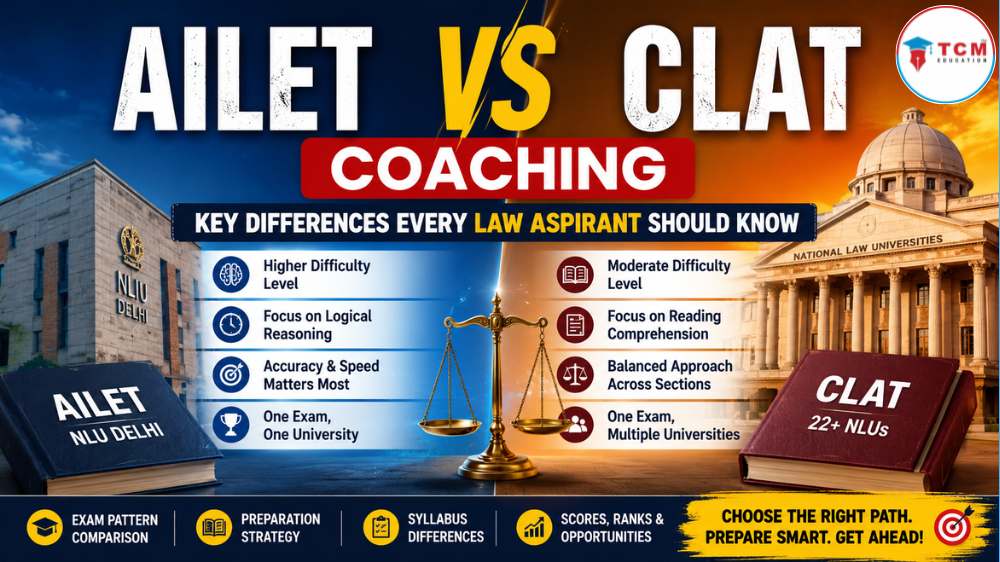
For students trying to build a solid career in law, picking the right entrance exam preparation strategy is, well, basically one of the most important decisions. Among the most popular law entrance exams in India, CLAT and AILET do stand out as the preferred choices for thousands of students each year, and it’s not just hype. While both tests do open doors to well known law universities, their exam patterns, competition levels, and preparation needs are not the same at all.
Knowing these differences can help CLAT Law Aspirants pick the more suitable coaching approach and, in a sense, maximize their chances of getting admission into a top tier law school
Understanding CLAT and AILET
The Common Law Admission Test (CLAT) is conducted for admission to National Law Universities (NLUs) across India. Meanwhile the All India Law Entrance Test (AILET) is conducted only for admission to the National Law University, Delhi (NLU Delhi).
Even if both exams test legal aptitude, logical reasoning, English current affairs, and quantitative aptitude, the competition intensity and exam structure still demand distinct preparation strategies.
Why Coaching Matters for Law Aspirants
Competitive law entrance exams seem to get tougher each year. A structured coaching program gives expert guidance, study materials, mock tests, and also some sort of personalized mentoring which helps students stay on track.
For many Law Aspirants, coaching works like a roadmap that makes preparation feel more organized and it improves performance through repeated practice, and feedback from experts, that kind of thing.
Key Differences Between AILET and CLAT Coaching
1. Exam Pattern Focus
CLAT Preparation Focuses On :
- Reading comprehension question style, not just reading in general
- Current affairs + legal reasoning
- Time management for those long passages, you know the ones
- Analytical thinking , and how you interpret what you read
AILET Preparation Focuses On :
- Logical reasoning at a higher difficulty level
- Solving questions faster, but not randomly
- Keeping accuracy even when the clock is aggressive
- Advanced critical thinking, like deeper interpretation
So, because of that, coaching programs made for AILET usually have more intensive logical reasoning exercises compared to the ones designed for CLAT courses.
2. Competition Level
In CLAT, seats are offered across multiple NLUs, so the competition is spread out a bit
In AILET, admission is limited to NLU Delhi only , so it tends to feel much more intense
Because of this situation :
- AILET coaching leans heavily on precision, plus practice at advanced level
- CLAT coaching is more about broader preparation, covering multiple sections in a well rounded way
If students are trying for both exams, they must plan a strategy that matches what each test actually asks, not just “general prep”.
3. Mock Test Strategy
Mock tests matter a lot for law entrance preparation, honestly they’re non negotiable
For CLAT aspirants, mock tests mostly train :
- Reading speed
- Passage analysis
- Sectional balance
- Time allocation, in real time
For AILET candidates, mock tests are more about :
- Logical reasoning mastery
- Decision-making under pressure, quickly but calmly
- Accuracy upgrades
- Speed enhancement, while staying correct
A good coaching institute should provide exam specific mock tests, so students get used to the real exam conditions, and not just practice in theory.
4. Current Affairs Preparation
Lately, current affairs seem like they have become even more relevant in law entrance exams, in a way that feels almost unavoidable.
In CLAT coaching, students are trained to:
- Analyze news events critically
- Understand legal implications of current issues
- Improve comprehension-based answering skills
In AILET coaching, the current affairs routine often leans toward:
- Static GK integration
- Direct factual knowledge
- Quick recall techniques
So this difference is basically the reason why students shouldn’t bank on one single prep method for both exams, because the emphasis shifts, even if the topic name sounds the same.
5. Study Material and Practice Resources
Good coaching programs usually don’t just “give material”, they provide something more tailored, aligned with what the exam actually asks.
For CLAT preparation, the resources typically include:
- Reading-heavy passages
- Editorial analysis
- Legal reasoning case studies
- Current affairs compendiums.
For AILET preparation, resources more often look like:
- Advanced logical reasoning sets
- Critical reasoning tasks
- High difficulty practice papers
- Speed-building worksheets.
The best coaching systems customize these study inputs, so students can handle the specific pressures of each examination without feeling like the syllabus is generic
AILET Preparation Guide for Serious Aspirants
If someone is targeting NLU Delhi, they should follow a dedicated AILET Preparation Guide, one that supports both conceptual clarity and intensive practice routines, side by side.
Key recommendations include
Build Strong Logical Reasoning Skills
build strong logical reasoning skills, because often logical reasoning kinda decides the final rankings in AILET. Students should solve a wide variety of reasoning questions daily, no skipping days.
Prioritize Accuracy
Prioritize accuracy too, since the competition is extremely high, even small mistakes can impact rankings in a big way. So during practice sessions, keep your focus on reducing errors as much as possible.
Take Regular Mock Tests
Also take regular mock tests, try to attempt full length mocks every week and then analyze your mistakes carefully so the weaker topics become obvious.
Improve Time Management
Work on time management, because you need strategies for handling difficult questions, without wasting valuable exam time.
Strengthen Current Affairs Knowledge
Don’t ignore current affairs knowledge, maintain a steady habit of reading newspapers and monthly current affairs magazines consistently, this part matters more than people think.
Effective AILET preparation strategy
A successful AILET preparation strategy should include some basics like a
Daily study plan
- For example 2 hours for logical reasoning
- 1 hour for English language
- 1 hour for current affairs
- 30 minutes for quantitative aptitude.
Along with that, do regular revision sessions.
Then keep a weekly performance review
Track things like
- Your accuracy percentage
- Mock test scores
- The time spent per section
- also the areas requiring improvement.
Focus on Weak Sections
Try to add extra study hours to the areas where your score is still below the average threshold. This way you don’t just “repeat” content, you actually improve the weak parts.
Practice Under Exam Conditions
When you simulate real exam conditions, it builds familiarity, and it quietly boosts confidence. Also it helps a lot with the exam-day stress, because everything feels more familiar.
Can CLAT Aspirants Prepare for AILET Simultaneously?
Yes, it’s possible.
Many top candidates manage both examinations together, because the syllabus overlaps quite a bit. Still, CLAT aspirants need extra attention on advanced reasoning and also on speed-building exercises, so they can realistically match what AILET expects.
A balanced preparation plan should generally include
- CLAT reading practice with more focus
- AILET logical reasoning drills, daily if possible
- Regular mock tests for both exams
- Steady current affairs revision
With the right guidance, students can aim for both exams, without letting one preparation phase damage the other.
Why TCM Education is a Trusted Choice for Law Aspirants
At TCM Education, students are given structured support for competitive law entrance exams. The emphasis is on concept clarity, exam-ready preparation strategies, personalized mentoring sessions, and a comprehensive mock test program that actually trains you for timing.
Whether students are targeting CLAT, AILET, or both at the same time, TCM Education offers the academic backup plus the strategic direction needed to stay confident when exam day arrives.
Conclusion
Deciding between CLAT and AILET coaching needs a clear understanding of the differences in exam pattern, competition levels, and what preparation really demands. Even though both exams test similar skills, their style and difficulty levels vary a lot, so specialized training matters.
For CLAT Law Aspirants, success comes from combining strong reading comprehension, current affairs awareness, and logical reasoning abilities with a focused preparation plan. By following a proven AILET Preparation Guide and implementing an effective AILET Preparation Strategy, students can significantly improve their chances of securing admission to India's leading law universities.
The right coaching, consistent effort, and strategic preparation can turn your law school dream into reality.