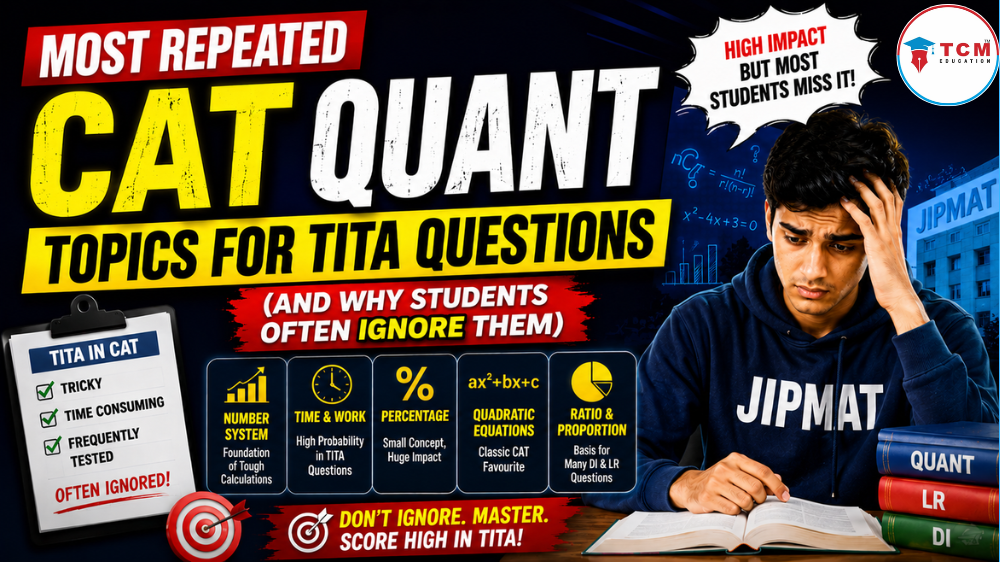
Some students skip TITA question.
Not because they couldn't solve them.
Because they were afraid of getting them wrong.
The irony, of course, was that TITA questions don't carry negative marking.
That conversation comes back to us every CAT season.
A lot of aspirants treat TITA questions like they're some mysterious part of the exam. In reality, they are often among the most rewarding questions in the paper. No options means no guesswork, but it also means no penalty for trying.
And when you go through previous CAT papers, you start noticing something else.
The exam changes every year, but certain Quant topics keep finding their way into TITA questions.
Not always in the same form. Not always with the same difficulty level. But they're there often enough that ignoring them would be a mistake.
Arithmetic: The Topic That Quietly Carries Quant
Let's start with the obvious one.
Arithmetic.
Most students spend months looking for shortcuts around it.
Usually, they end up coming back to it anyway.
Whether it is percentages, ratios, mixtures, profit and loss, or time and work, Arithmetic has been a regular feature of CAT for years. It is not flashy. Nobody gets excited about solving a mixture question.
But if you ask students who scored well in Quant, many of them will tell you the same thing: Arithmetic gave them confidence.
There is something reassuring about recognizing the underlying idea behind a question. CAT may wrap it in a complicated paragraph, but underneath, it is often testing a simple concept.
The students who see through the disguise usually save a lot of time.
Algebra: The Topic Students Fear More Than They Should
I have noticed that Algebra tends to divide CAT aspirants into two groups.
The first group enjoys it.
The second group delays it until the last possible moment.
Strangely enough, both groups are often exaggerating.
Most CAT Algebra questions are not asking you to become a mathematician. They are asking whether you can think clearly under pressure.
Quadratic equations, logarithms, functions, inequalities, and progressions have appeared repeatedly over the years. Some of them show up as TITA questions because CAT knows there is no shortcut once the options disappear.
You either understand the concept or you don't.
The good news is that understanding usually matters more than speed.
Number Systems: The Chapter Nobody Loves Until CAT Asks It
Number Systems has an odd reputation.
Students either love it or avoid it completely.
There doesn't seem to be much middle ground.
The funny part is that many Number System questions look harder than they actually are. A question involving remainders or divisibility can appear intimidating at first glance. Then you spend a minute thinking about it and suddenly the entire thing falls into place.
I've seen students spend hours chasing difficult Algebra questions while ignoring Number Systems entirely.
A few months later, they're wishing they had done the opposite.
Geometry: Less Formula, More Observation
If you're memorizing dozens of Geometry formulas, you're probably making life harder than necessary.
CAT has a habit of rewarding observation.
Many Geometry questions become easier once you draw a decent diagram and stop looking for a complicated solution.
Triangles and circles appear regularly. Coordinate Geometry shows up often enough to deserve attention. Mensuration makes occasional appearances too.
The challenge is rarely the formula.
The challenge is spotting what the question is really asking.
That skill comes from practice, not memorization.
The Mistake Many Aspirants Make
Around this point, some students start looking for a magic list.
A list of chapters that guarantees a high percentile.
Unfortunately, CAT doesn't work like that.
Every year, somebody asks me, "Can I skip this topic?"
The better question is usually, "How comfortable am I with the topics I already know?"
Strong CAT performers are rarely the students who finish the most material.
They're often the students who know a smaller set of concepts extremely well.
What Previous CAT Papers Actually Teach Us
If there's one lesson from recent CAT papers, it's this:
The exam rewards understanding.
Not tricks.
Not shortcuts.
Not last-minute formula sheets.
Students sometimes underestimate how far strong fundamentals can take them.
A candidate who understands Arithmetic, Algebra, Geometry, and Number Systems properly will usually feel much calmer on exam day than someone who has rushed through the entire syllabus.
And calm students tend to make better decisions.
That matters more than most people realize.
How TCM Education Approaches CAT Quant
One thing we've learned at TCM Education after working with hundreds of CAT aspirants is that students don't struggle because they're incapable.
Most struggle because they don't know what deserves their attention.
There is an endless amount of CAT content available online. Videos. PDFs. Question banks. Strategy guides.
The problem isn't finding material.
The problem is figuring out what actually matters.
That's why our focus remains on building strong fundamentals, practicing exam-level questions, analyzing mistakes honestly, and helping students develop the confidence to tackle unfamiliar problems.
Because no matter how CAT changes, confidence built on preparation never goes out of style.
Final Thoughts
If you're preparing for CAT 2026, don't obsess over predictions.
Nobody knows exactly what the paper will look like.
What we do know is that Arithmetic, Algebra, Number Systems, and Geometry have repeatedly played important roles in TITA questions.
Start there.
Work steadily.
Take mocks.
Review your mistakes.
Then repeat the process.
It sounds almost disappointingly simple.
That's because it is.
Most CAT success stories aren't built on dramatic breakthroughs.
They're built on ordinary study sessions that happened consistently for months.
The students who eventually score 95, 98, or 99 percentile are rarely doing something magical.
More often than not, they're simply doing the basics well for a very long time.
And that's good news.
Because it means the path is available to anyone willing to follow it.